Replace your HIL bench with deterministic simulation.
Run firmware regression tests on every commit — ARM Cortex-M, RISC-V, Xtensa, any MCU. Silicon-validated. Reproducible. Parallel.
No benches, no cables, no flaky tests.
Same firmware, same cycle-exact result every run. No cable jitter, no power noise, no "ghost bug" race conditions. Bugs reproduce in CI, not just on Friday afternoons.
⚡
Parallel & cheap
~6,000× wall-clock speedup means a 30-minute suite runs in seconds. Spawn 50 concurrent jobs across hardware variants. No queueing for the one rig in the lab.
🔬
Observable
Every run produces a JSON result + VCD trace + UART log + cycle-by-cycle PC history. Diff traces between commits to find regressions instantly.
Drop it in
One YAML file. Zero hardware.
Add the LabWired GitHub Action to any repo with a Rust or C firmware target. Push a commit — see the
simulation run. JUnit XML for your CI dashboard, JSON for your custom tooling.
Opens GitHub’s editor with the workflow already written — press
“Commit new file” and the next push runs. The commit is yours, made with
your own account: LabWired never gets write access to your repository.
Starting a new project?
Use the starter template
— it ships a prebuilt example, so the first push runs a simulation with no toolchain.
Don’t take our word for it. Every Tier-1 peripheral we claim is proven by a CI run
you can open — chip by chip, peripheral by peripheral, refreshed nightly.
See the validation matrix →
Live proof
Real repos, running in CI right now.
Public projects running deterministic LabWired simulation on every commit —
not a screenshot, the actual latest run.
How we compare
Built for the regression suite that has to ship.
LabWired CI
Wokwi CI
Renode
HIL bench
Multi-arch silicon-validated
✓
~
✓
✓
VCD trace per run
✓
—
✓
~
Parallel concurrency
unlimited
per plan
self-host
1 per bench
Setup time
< 1 s
< 1 s
hours
2–4 hours
Bench dependency
none
none
none
dedicated rig
Determinism guarantee
cycle-exact
best-effort
cycle-exact
flaky
VS Code timeline
✓
✓
✓
—
Fault injection
roadmap
—
✓
manual
Open-source core
✓
—
✓
n/a
Wokwi is great for prototyping and IoT. Renode is best-in-class for low-level peripheral fidelity on the
desktop. Our wedge: silicon-validated STM32 with a zero-setup browser playground and
drop-in CI. The right answer for any embedded team that ships firmware — STM32, RP2040, ESP32, nRF52, RISC-V dev kits, custom Cortex-M SoCs.
Custom hardware
Need your board modeled?
We build local MCU and peripheral models for your firmware workflow, with repeatable tests and optional CI integration.
Start with a free feasibility check, then agree the scope and quote before implementation.
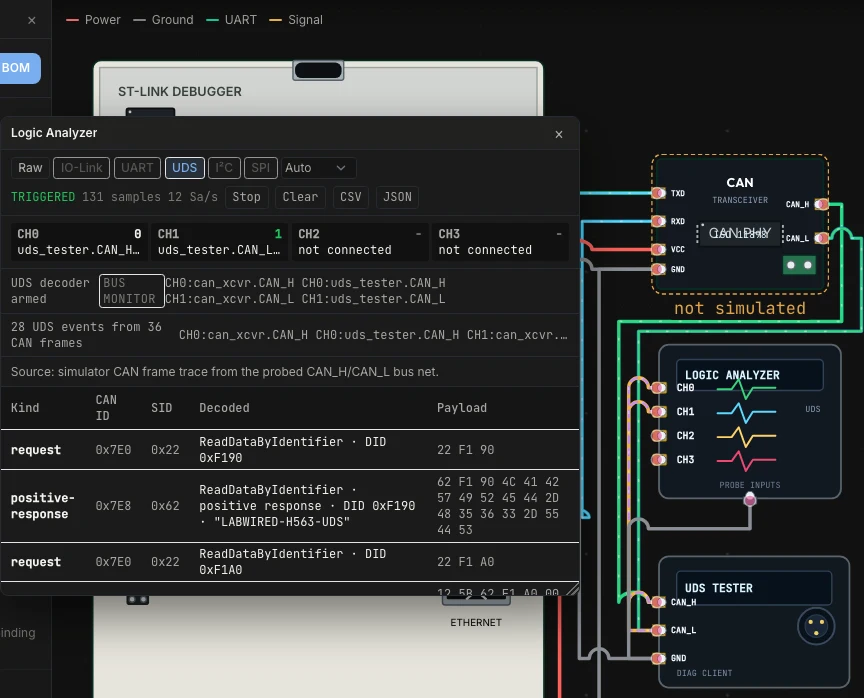
Two virtual STM32H563 boards share a simulated FDCAN bus. The tester sends all 27
ISO 14229 services and the run passes only when every response matches.
This is evidence from the simulation model, not a measurement of physical hardware.