opamp
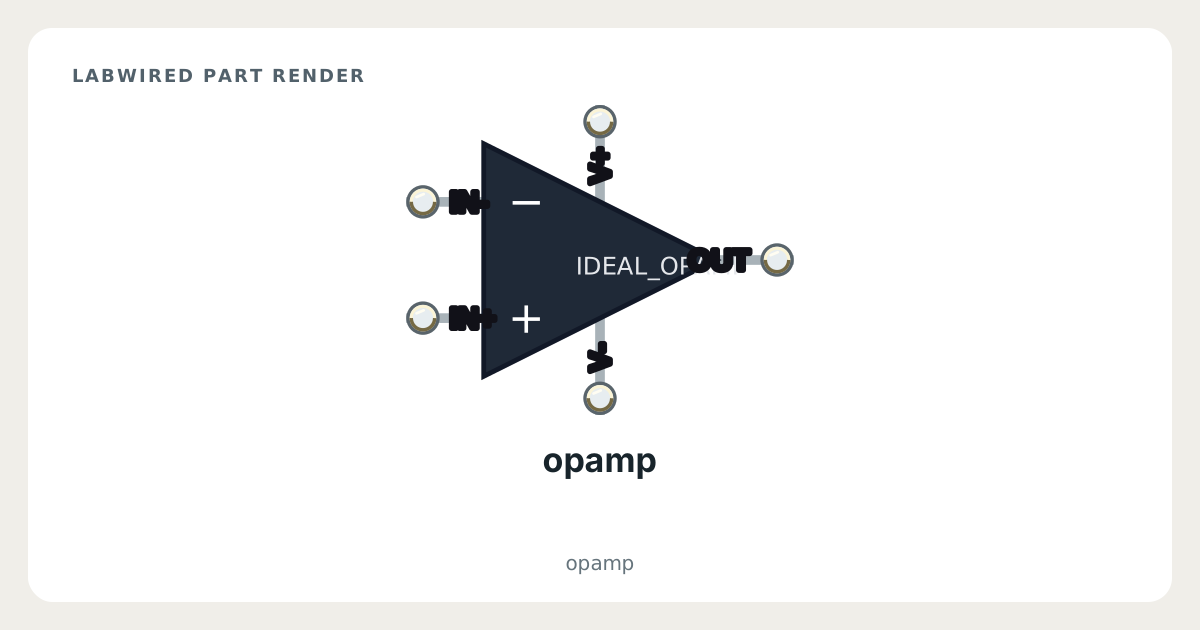
The opamp is a passive, analog or power part in the LabWired part catalog. Its catalog type is opamp. It has 5 pins. No device model of its own. On a signal net it is an element of the in-core analog circuit, solved next to the running firmware; wired only across supply rails (a decoupling capacitor, for example) it stays wiring only. Semiconductor models are large-signal, with no device capacitance.
From the catalog: Behavioural op-amp (X line, core IDEAL_OPAMP card unless attrs.model names another): AOL, GBW single pole, VOS, rail clamps, ROUT. No slew limit beyond the pole, no input bias current, no output current limit.
Key facts
| Category | Passive, analog and power parts |
|---|---|
| Catalog type | opamp |
| Pins | 5 |
| Datasheet | TI LM358 op-amp datasheet |
What LabWired simulates
Analog circuit element
Not applicable
opamp pinout
- Other signals: IN+, IN-, OUT, V+, V-
| Pin | Electrical type | Function |
|---|---|---|
IN+ | Passive | — |
IN- | Passive | — |
OUT | Passive | — |
V+ | Passive | — |
V- | Passive | — |
How to simulate the opamp in LabWired
- Open the Playground at app.labwired.com and place an MCU board.
- Add the opamp (catalog type opamp).
- Connect IN+, IN-, OUT, V+ and V- as your circuit needs.
- Run the firmware. When the part is in an analog circuit, as described above, the in-core analog solver computes it next to the firmware.
Related Passive, analog and power parts
All Passive, analog and power parts · All parts
Modelled from TI LM358 op-amp datasheet.